
Story-making tools
How to Turn Your Child's Story Idea Into a Book
When a child retells the same made-up adventure, one odd detail is often non-negotiable: the bus has a square wheel, the dragon only eats toast, or the moon speaks in whispers. Capture that detail before trying to make the story tidy.
Keep the division of labor simple
The child supplies the story anchors; the adult helps record and arrange them. Capture the character, goal, obstacle, must-keep detail, and ending before choosing how the book will be made.
Five-question worksheet
Capture the story before you improve it.
Ask these questions in order. Write down the child's answer before suggesting your own.
One-sentence capture sheet
My story is about ______. They want to ______, but ______. The detail that must stay is ______. At the end, ______.
Who is the story about?
Record the name, creature, object, or group exactly as the child describes it.
What do they want?
Give the story one clear destination, task, discovery, or wish.
What gets in the way?
A small problem gives the middle of the book somewhere to go.
Which detail must not change?
Save the strange rule, repeated phrase, special object, or visual detail the child keeps correcting.
How does it end?
Let the child choose the final image or action, even if it is surprising.
Adult role
Be the scribe without taking over.
The adult's job is to make the idea easier to follow, not more ordinary.
- Read the answers back so the child can correct names, colors, rules, and the ending.
- Ask one missing question at a time; a string of suggestions can replace the original idea.
- Mark additions clearly. If you invent a bridge between events, ask whether it belongs.
- Keep the child's language where it carries the idea.
- Save the first version so the source idea remains separate from later edits.
A made-up example
Nia's moon bus, from spoken idea to book shape.
Here is how one playful idea can move from a spoken sentence to a simple beginning, middle, and ending.
The spoken idea
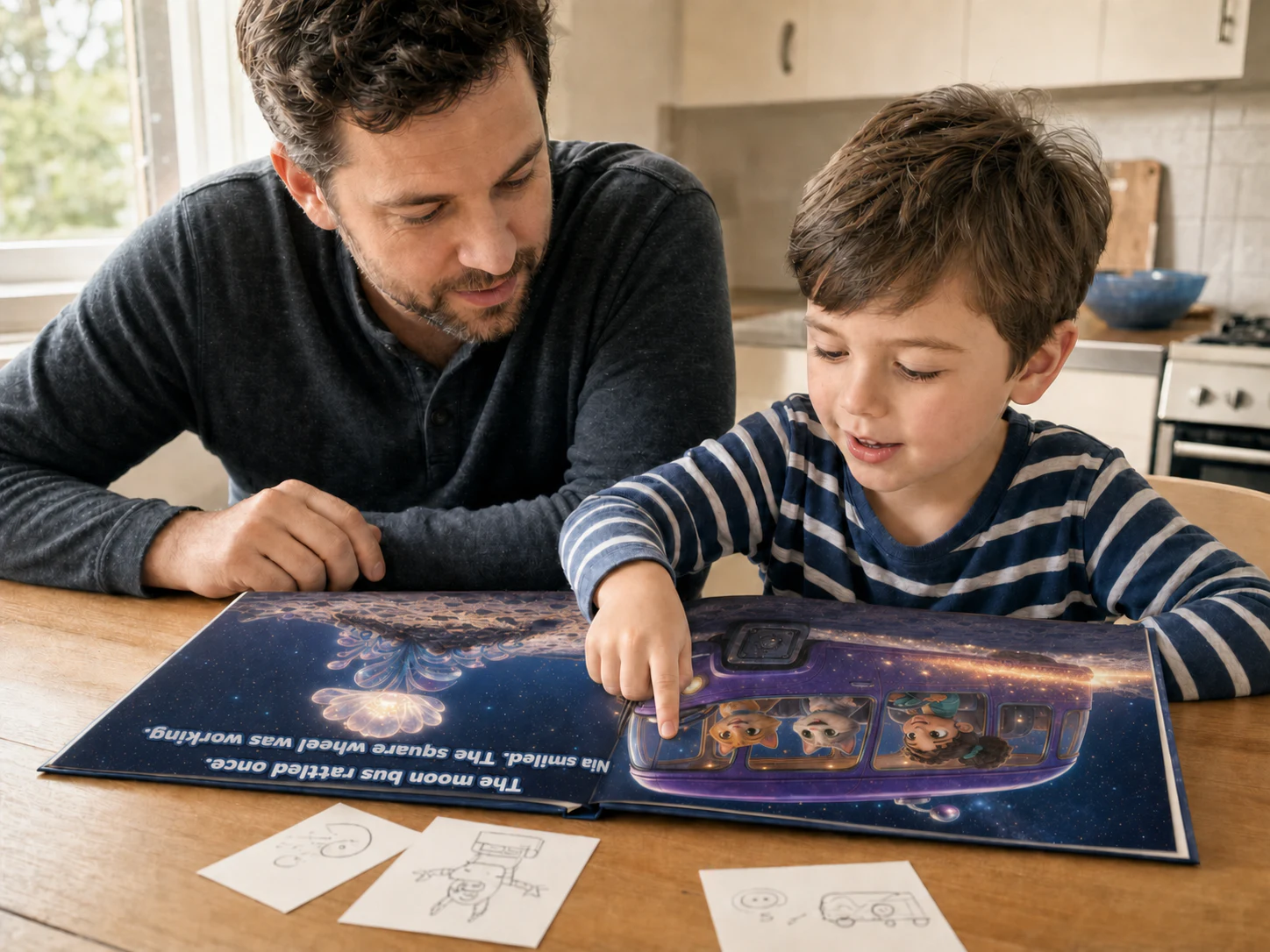
Nia drives a purple bus to the moon. It only stops for cats. One wheel is square. At the end, all the cats ring the bell.
Opening
Nia opens the purple moon bus and checks the square wheel. At each stop, another cat climbs aboard.
Middle
The road grows steeper and the square wheel bumps harder. Nia and the cats find a gentler route.
Ending
The moon appears over the final hill. The bus arrives with its square wheel still square, and every cat rings the bell.
Choose how to make it
What needs to remain unchanged?
Choose a reproduction path when verbatim preservation is the point. Choose an assisted path when transformation is welcome and the family is prepared to review it.
Final story check
Ask whether the idea still belongs to the child.
If the must-keep detail or the ending disappears, return to the capture sheet. The story may be smoother, but it is no longer preserving the idea that made the child repeat it.
- The original main character is still here.
- The character is still trying to do the same thing.
- The must-keep detail survived.
- The ending still belongs to the child.
- The adult additions can be identified and explained.
Turn the idea into a book
Keep the child's five anchors beside you.
If the child wants to step inside a newly illustrated version of their idea, begin with the capture sheet: character, goal, obstacle, must-keep detail, and ending. That little list is the heart of the book.
Tippytale can build a new story from those anchors, with the child at the center and optional family members, friends, or pets beside them.
The wording and images will be newly created rather than copied from the child's original pages. Keep the five anchors close so the finished story still feels unmistakably theirs.
Example Story Idea
A purple bus travels to the moon. It only stops for cats, one wheel is square, and at the end every cat rings the bell.
Use their idea: Swap in the five answers from the worksheet.
You can read and edit the complete digital story before deciding on print.
Copy it first, then paste it into the Story Idea field.
FAQ
Questions about preserving a child's story idea.
Do I need a finished manuscript to make a book?
No. A clear character, goal, obstacle, must-keep detail, and ending can be enough to make a handmade book or brief an assisted story service. A finished manuscript is better when every sentence must remain unchanged.
Will a generated book preserve my child's exact words?
Do not assume it will. A generated story can reshape wording, pacing, scenes, and illustrations. If exact preservation matters, use a layout or printing path where you control the manuscript and art directly.
Can I include a friend, family member, or pet in a Tippytale story?
Yes. You can add family members, friends, or pets beside the child. Include the part each character plays in the idea, then review how they appear in the generated direction, artwork, and complete digital book.
What if my child wants to illustrate the book?
Make the original drawings the book. Bind the pages at home or choose a service that reproduces supplied artwork. Tippytale is a better fit when newly generated illustration is welcome.