
Relationship gifts
Personalized Book for Best Friends: Make Both Kids Matter
A best-friend book can contain two names and still feel like one child's story. The better test is agency: does each child make a choice, contribute something distinct, and change how the story ends?
The equal-agency answer
A shared friendship story needs consequential roles for both children. Give each friend one decision and one distinct contribution; if removing either child leaves the plot unchanged, the story is not balanced enough.
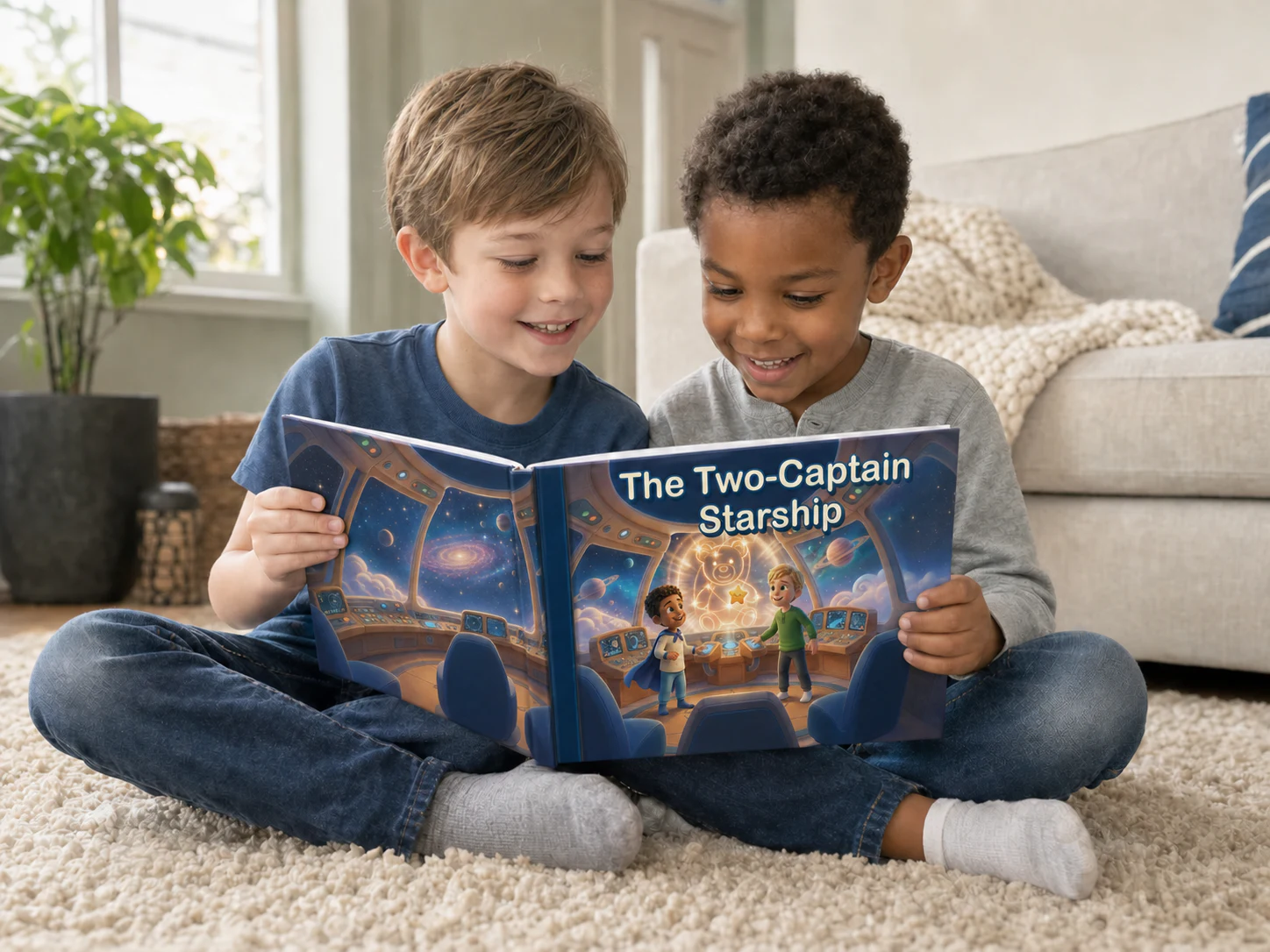
The equal-agency test
Remove either child in your head. Does the story still work?
Read the product sample or story outline once, then imagine removing either child. If the plot still works almost unchanged, the second child is probably decoration or a helper.
Five-detail friendship brief
Replace generic friendship language with things they recognize.
The most useful input is not 'They are best friends.' Give the story five pieces that create a relationship on the page.
Their repeated thing
What do they do without needing a plan: build pillow forts, invent dance moves, collect smooth stones, draw maps, trade jokes, or race scooters to the same tree?
One difference that helps the plot
One child may notice tiny clues while the other sees the whole route. Keep the contrast kind and useful; neither child should become the permanent sidekick.
A place they both recognize
Use a backyard gate, apartment hallway, playground bridge, grandparent's kitchen, or invented clubhouse. A concrete place carries more recognition than several adjectives about friendship.
A problem that needs both of them
Choose a challenge with two connected parts: map a path and decode the signs, build a boat and find the sail, or calm a nervous dragon and open the lantern gate.
The detail that makes them laugh
Add a shared phrase, a made-up team name, a snack they split, or a tiny mishap they would recognize.
Worked example
Balanced roles can be different roles.
Maya and Zoe discover that the lanterns along their imaginary garden trail have gone dark. Maya remembers the winding route they drew in chalk; Zoe recognizes the bird calls that mark each turn. Maya rebuilds the map while Zoe finds the final signal, and they light the gate together.
Remove either contribution and the solution no longer works. That is what makes the roles feel balanced.
Choose the format
A friendship story is one option, not the automatic answer.
A personalized book earns its place when relationship details change the story instead of merely decorating it.
Photo book
Choose it when the gift should preserve real trips, school years, and candid moments.
Paired token
Choose it when you need a small, immediate gift the children can each keep.
Shared outing
Choose it when time together matters more than another object.
Fixed two-child book
Choose it when a predictable sample and established plot matter most.
Custom friendship story
Choose it when their place, repeated game, contrasting strengths, or invented world is the reason for the gift.
A friendship worth remembering
Celebrate the friendship now without promising forever.
Children's friendships can grow, change, pause, and return. The book does not need 'best friends forever' language to feel generous. It can honor a shared year, a move, a birthday, a team, or an ordinary ritual the children enjoy right now.
For every map we drew this summer sounds more like a real relationship than nothing will ever change us.
Give both children a role
Start with a problem that needs both of them.
In Tippytale, one child begins at the center and their friend joins the story alongside them. Give each child a different contribution so the friendship shapes what happens, even when their roles are not identical.
A Story Idea to Make Their Own
Two best friends discover a locked lookout above their favorite meeting place. One spots a star-shaped clue, the other builds a path across a gap, and together they reopen the lookout before sunset.
Make it theirs: Add their favorite meeting place, one strength for each child, and something they always do together.
You can read and edit the complete digital story before deciding on print.
Copy it first, then paste it into the Story Idea field.
FAQ
Questions about two-child friendship stories.
Can both friends appear in a Tippytale story?
Yes. Begin with one child and add their friend as a supporting character. In the story idea, give each child a different contribution, then review the completed book to make sure both children affect what happens.
Does equal agency mean both children need the same number of pages?
No. It means each child contributes something the plot needs. One may lead one scene and the other may unlock the next; the shared finish should depend on both.
What if I want to use real friendship photos?
A photo book is usually the better format when documentary memories are the point. A storybook is better when you want to transform recognizable details into an imagined plot.
Is this only for two girls or two boys?
No. Build the story around the two children's actual relationship, interests, and preferred roles rather than a gendered friendship script.
Helpful context