
Writing help
What to Write in a Christening Book: Original Inscription Examples
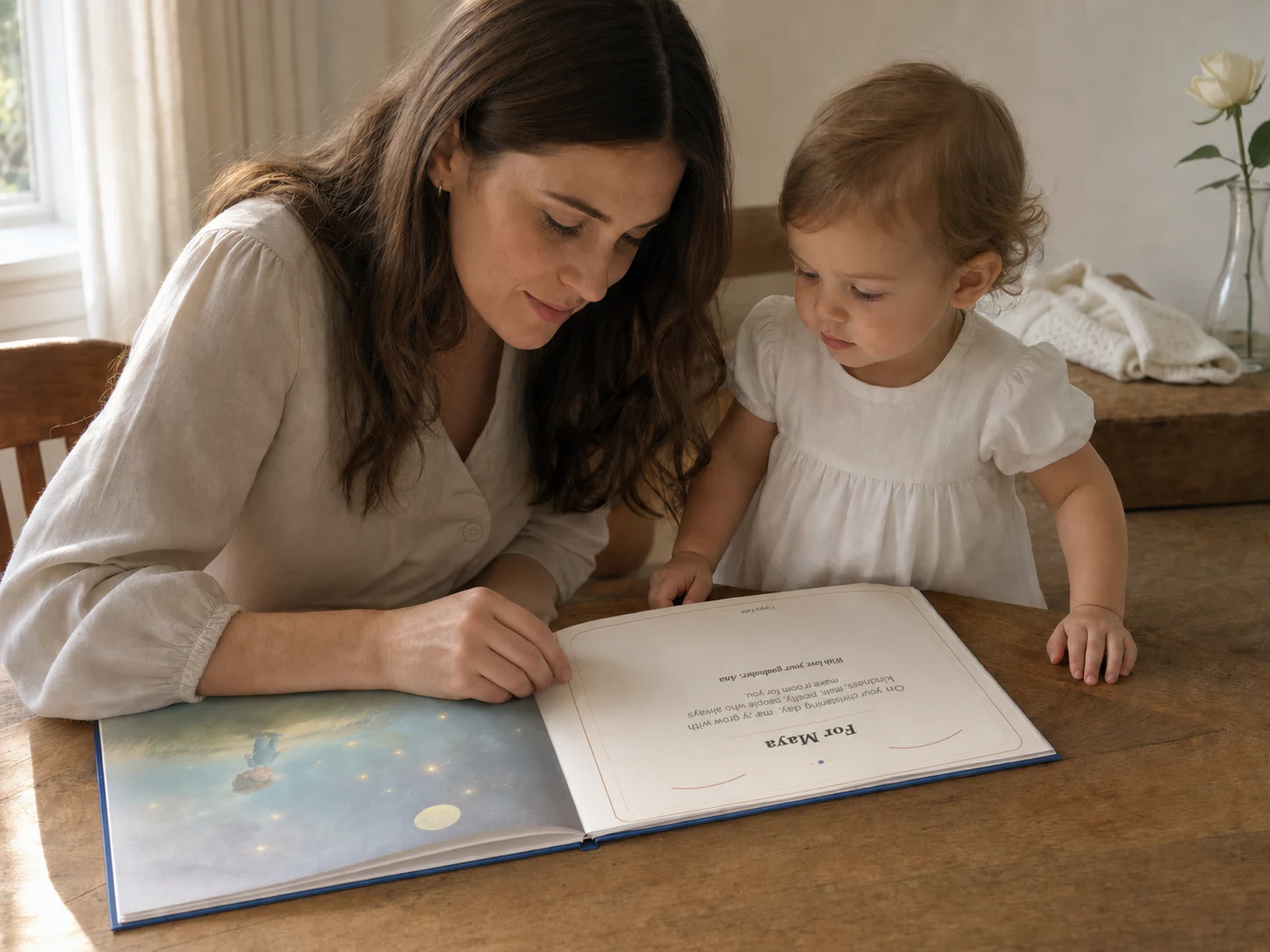
A christening book message may be read long after the ceremony. Write for that future rereading: name the child, sound like yourself, and use only the faith language you know fits the family.
Keep it personal and proportionate
For a short message: ‘Dear Lena, may this book always remind you how warmly you were welcomed. With love on your christening day, Aunt Rosa.’ Keep your own inscription to two to four sincere sentences, use the family's faith language, then add your name and the date.
Four writing decisions
Choose the audience and language before the sentence.
You do not need a quotation or a miniature sermon. Make these four decisions first, then write in your own voice.
Who is giving the book?
A godparent may name the relationship and a personal commitment. A grandparent may write about family welcome. Other relatives and friends can focus on affection, presence, and why they chose this book.
Who should the message address?
Write to the child when the inscription is meant to be reread later. Write to the parents when the book is mainly carrying a note of support to them. For a baby, it is still natural to address the future reader directly.
How faith-specific should it be?
Use the ceremony word and faith language the family uses. Mention a blessing, verse, sacrament, or denominational idea when it feels natural to the message.
How much space do you have?
For a small handwritten area, use a greeting, one meaningful sentence, and a sign-off. A separate letter is better when the message needs a full family story.
A flexible formula
Use a simple pattern, then make it sound like you.
The strongest line will be the one only this giver could write.
Inscription pattern
Dear [name], on your [christening or baptism] day, [say what this moment or relationship means]. May you [offer a hope that fits the family]. With love, [name and relationship], [date].
Original example library
Adapt the relationship and tone, not just the name.
These are original starting points, not scripture or liturgy. Adapt the relationship, tone, and faith language so the message sounds like you.
Short and warm
- 1.For Noah, with love on your baptism day and for every new chapter ahead. Love, Mia and Daniel.
- 2.Dear Ava, we chose this book for the child you are today and the person you will keep becoming. With all our love, June 14, 2026.
- 3.Dear Eli, may stories give you wonder, questions, and many reasons to turn one more page. With love on your christening day.
From godparents
- 1.Dear Theo, I am grateful to stand beside your family today and to be part of your life in the years ahead. I promise to listen, encourage you, and make time for the questions that matter to you. Love, your godmother, Ana.
- 2.Dear Maya, on your baptism day, I am honored to be your godparent. May you always know that you can come to me for a patient ear, an honest answer, and a place at my table. Love, Sam.
- 3.For Lucas, my wonderful godchild: I cannot know every road you will take, but I can promise to cheer for your courage and walk beside you when I can. With love, Uncle Ben.
- 4.Dear Iris, today I became your godparent, and that is a role I will carry with care. May this book remind you that your story has a loving circle around it.
From grandparents
- 1.Dear Sophie, your christening day brings another beautiful day into our family's story. We look forward to reading with you, learning from you, and watching your own traditions take shape. Love, Grandma and Grandpa.
- 2.For Mateo, with joy on your baptism day. May you grow up knowing the stories, laughter, and love that connect you to your family. Love always, Nana.
- 3.Dear Grace, we chose this book so you would have something from us to hold now and read again later. You have been loved from the very beginning. Grandad and Jo.
- 4.For our dear grandson Leo: may you meet the years ahead with kindness, curiosity, and people who help you feel at home. With all our love on your christening day.
From relatives and friends
- 1.Dear Ruby, today we celebrate you and the family gathered around you. May this book find you on quiet afternoons, rainy mornings, and many happy rereads. Love, Aunt Claire.
- 2.For Finn, on your baptism day: may you grow with good questions, generous friends, and the confidence to be kind. With love, Priya and Mark.
- 3.Dear Zoe, we are so happy to share this day with your family. May you always know there is room for you in our home, at our table, and in our hearts.
- 4.For Henry, with affection on your christening day. We hope this book becomes one small part of a childhood full of stories and people who show up for you.
Faith-centered wording
Start with the family's vocabulary, not a quote list.
A personal sentence such as 'We will be glad to share in your life of faith' is warmer and more sincere than trying to define what the ceremony means for every tradition.
If a scripture verse is important, quote it accurately and distinguish it from your own message.
What to leave out
Protect the future rereading.
A lasting inscription should still feel comfortable when the child is old enough to read it independently.
- A message copied from another person's card or inscription.
- A sweeping promise about the child's whole future.
- Faith language you are unsure the family uses.
- A long explanation addressed only to adults when the child is the future reader.
- So much text that the handwriting becomes difficult to read.
When the story belongs beside the message
Let the inscription open a story made for the child.
This guide works with any suitable children's book. A standard title may be the best choice when it already matters to the family. A card or letter is better for a long message. A denominational book may fit better when faith teaching is the main purpose of the gift.
The idea below can become an illustrated Tippytale story with the child at the center and family members beside them. Let your handwritten message do the personal speaking at the beginning.
A Story Idea to Make Their Own
On the evening after a family celebration, the child finds a small lantern glowing in a garden. Each person they love adds a light to the path, and the child carries the lantern home as a reminder that they are surrounded by a loving circle.
Make it theirs: Add the family celebration, the people surrounding the child, and a meaningful place or family detail.
You can read and edit the complete digital story before deciding on print.
Copy it first, then paste it into the Story Idea field.
FAQ
Questions about wording and family tradition.
Should I write christening or baptism in the book?
Use the word the family and their faith community use for the ceremony. If you are unsure, ask the parents rather than treating the terms as interchangeable in every tradition.
Should a christening book inscription address the baby or the parents?
Address the child when the message is meant to be reread later. Address the parents when the book is mainly carrying a note of support to them. Either can be appropriate; make the audience clear.
Should I include the date and church?
The date is useful context for future rereading. Add the place only when you know the exact wording and the family would value it; it is not required.
Is it appropriate to use a Bible verse?
It can be when it fits the family and tradition. Quote the reference accurately and distinguish it from your own message.
Helpful context